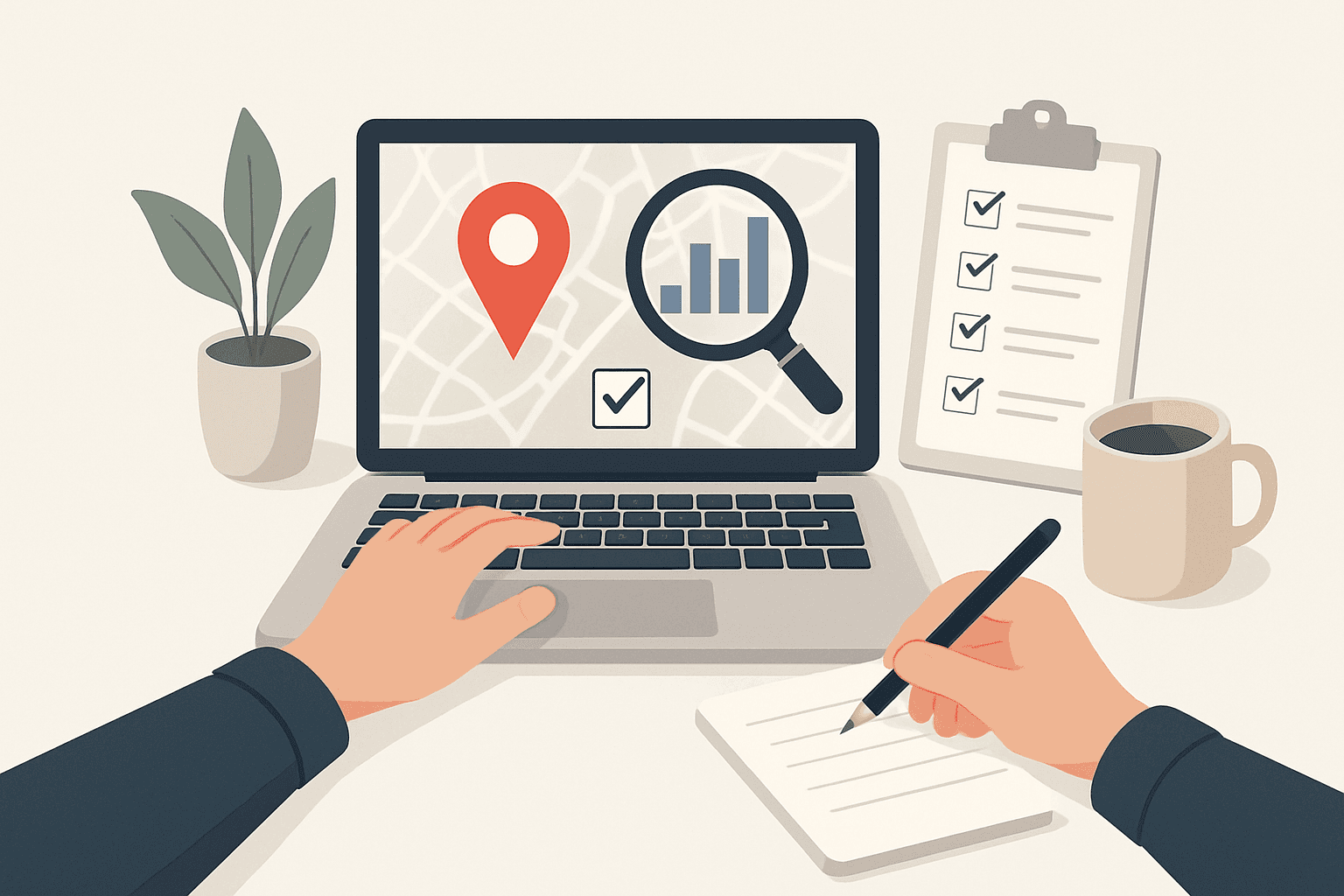
Local SEO Audit: A Step-by-Step Guide for Small Businesses
Run a local SEO audit that finds real ranking gaps. Follow our practical checklist covering GBP, citations, reviews, and on-page signals to win local search.
A local SEO audit is a structured review of every online signal that determines whether your business appears when nearby customers search for what you sell. It covers your Google Business Profile, citation consistency, on-page keywords, backlinks, and reviews so you can find the exact gaps costing you local visibility and fix them in priority order.
What Is a Local SEO Audit and Why Does It Matter for Local Businesses?
A statistic worth sitting with: according to Think with Google, 76% of people who conduct a local mobile search visit a business within 24 hours. That means the gap between ranking and not ranking in local search is not an abstract marketing metric. It translates directly to phone calls, foot traffic, and revenue. For small businesses competing against better-funded regional chains, a systematic local SEO audit is one of the most high-leverage investments of time available.
The audit functions as a diagnostic, not a one-time fix. It surfaces exactly which signals Google is weighing, where your presence falls short, and which repairs will move the needle fastest. A comprehensive local SEO audit framework treats each ranking layer as a separate inspection item rather than lumping everything into a single vague "improve your SEO" recommendation. Run one properly and you leave with a ranked punch list, not a folder of reports you never open.
For active businesses, the recommended cadence is at minimum once every 6 months. Google's local ranking algorithm weighs three core factors: relevance, distance, and prominence. All three can shift as competitors update their profiles, as citation errors accumulate, and as Google rolls out core algorithm updates.
How does a local SEO audit differ from a standard SEO audit?
A standard SEO audit focuses on site-wide technical health and domain authority: crawl errors, page speed, canonical tags, and backlink volume. A local SEO audit adds three additional layers that standard audits skip entirely. First, it inspects the Google Business Profile GBP for completeness and accuracy. Second, it checks NAP (Name, Address, Phone) consistency across every citation directory where the business appears. Third, it evaluates review signals, because a local search engine like Google Maps operates on a separate algorithm from the organic blue-link results most people associate with SEO.
Which local search visibility signals does an audit actually measure?
A properly scoped audit measures all of the following signals:
- GBP completeness: All fields populated, primary category correct, services and attributes listed.
- Citation consistency: NAP character-for-character identical across every directory.
- Proximity: Physical or service-area distance to the searcher, which the audit confirms is accurately represented.
- Review count and average rating: Volume and recency both factor into prominence.
- On-page local keywords: City and service terms in title tags, H1s, and meta descriptions.
- Structured data/schema: Local business structured data implemented correctly on the homepage.
- Local backlink authority: Links from city news sites, chambers of commerce, and regional directories.
- Behavioral signals: Click-through rate, direction requests, and phone calls from GBP.
Google's three local ranking factors, relevance, distance, and prominence, map directly onto these eight signal categories.
Who should run a local SEO audit and how often?
Any business that depends on foot traffic, service-area customers, or inbound phone inquiries should audit regularly. The recommended cadence: a full audit every 6 months, plus a lighter monthly check on GBP accuracy and review velocity. Solo operators can self-audit using free tools in roughly 4 to 5 hours. Agencies managing 10 or more locations should use paid platforms to manage scale. Even businesses with strong rankings benefit from audits because Google core updates happen 3 to 4 times per year and can erode positions without any visible warning. For more on this, see related guide. See also: optimize your Google Business Profile.
Key Factors That Affect Your Local Search Rankings
Why does the competitor two blocks away outrank you even though your business has been open longer? The answer almost always comes down to a handful of measurable ranking factors, and most of them are fixable once you know where the gap is. Here's what Google's local algorithm is actually weighing.
| Ranking Factor | What Google Measures | Audit Priority |
|---|---|---|
| GBP Completeness | All fields filled, correct category, current hours | High |
| NAP Consistency | Identical Name, Address, Phone across all citations | High |
| Review Score and Volume | Count, average rating, recency, response rate | High |
| Local Backlinks | Links from regionally relevant, authoritative domains | Medium |
| On-Page Local Signals | City/service in title tags, H1s, footer NAP, schema | Medium |
| Behavioral Signals | CTR, calls, direction requests from GBP | Low |
These factors are not equally weighted, but they are all measurable. The table above reflects audit priority based on how directly each factor responds to deliberate owner action.
Google Business Profile completeness and accuracy
The Google Business Profile GBP is the single highest-leverage audit item for any local business. Incomplete profiles leave money on the table because Google surfaces businesses it trusts, and trust is built through completeness. During your audit, check that your business name matches real-world signage exactly, your primary category is the most specific option available, all services are listed, and hours are current including holiday schedules. Photos matter too: profiles with photos receive significantly more requests for directions, according to Google's own data. For a full breakdown, review the Google Business Profile optimization tips on this site. The Google Business Profile help center also walks through every field in detail.
Local citations and directory listings consistency
Directory listings must carry identical NAP information across Google, Yelp, Facebook, Apple Maps, Bing Places, Yellow Pages, and any niche industry directories relevant to your category. Even minor discrepancies, "St." versus "Street" or a missing suite number, dilute the consistency signal Google uses to confirm your business is legitimate. BrightLocal's Local Citation Finder and Moz Local are the most widely used tools for scanning citations at scale. The FTC also provides guidance on maintaining accurate business information online. Aim to check at least 30 top directories during each audit cycle, and log every discrepancy in a spreadsheet before submitting corrections.
Backlink profile and the role of local authority links
Your backlink profile is Google's measure of prominence, and for local businesses, local links carry outsized weight relative to generic national ones. A link from the city's chamber of commerce, a regional news outlet, or a local blogger tells Google that your business is embedded in the community. Tools like Semrush or Ahrefs let you analyze competitor link profiles and find gaps. Even 5 to 10 high-quality local referring domains can meaningfully shift your prominence score in competitive local packs.
On-page signals tied to your service area and keywords
On-page local SEO covers title tags that include the city and primary service, for example "Plumber in Austin TX", an H1 that mirrors that intent, NAP embedded in the footer and contact page, service-area pages for multi-location businesses, and LocalBusiness schema on the homepage. Page speed and mobile-friendliness are technical prerequisites for this optimization work to land. Google's Core Web Vitals affect local keyword rankings indirectly through behavioral signals. For a deeper checklist covering every on-page element, the local SEO audit checklist on this site is a useful companion reference.
Reviews, ratings, and engagement as ranking inputs
Google explicitly states that review count, recency, and score influence local prominence. A business with 200 reviews averaging 4.4 stars will typically outperform a competitor with 30 reviews at 4.9 stars in a high-competition map pack, because volume and consistency signal ongoing customer activity. Responding to reviews signals engagement to Google's algorithm as well. Review velocity, meaning a steady stream of new reviews over time, matters more than a single burst. For a detailed look at the ranking mechanics, see why Google reviews matter for local ranking on this site. For more on this, see related guide. See also: comprehensive local SEO audit checklist.
How to Perform a Local SEO Audit: A Practical Step-by-Step Checklist
A bakery owner in Denver ran her first local SEO audit after six months of flat foot traffic. Within 3 weeks of fixing the issues it surfaced, a suspended GBP, 12 conflicting citations, and zero review responses, her Google Maps calls increased by roughly 30%. The audit itself took under 4 hours. Here is the same 6-step process, structured so any non-technical business owner can follow it start to finish.
Step 1, Audit your Google Business Profile for gaps and errors
- Log into your GBP dashboard at business.google.com.
- Verify every field is complete: business name, address, phone number, website URL, primary category, business description (use all 750 characters available), attributes, products, and services.
- Check your photos: aim for a minimum of 10 photos, with at least one uploaded within the last 90 days. Refer to the Google Business Profile photo guidelines for sizing and format standards.
- Search your business name in Google Maps to confirm no duplicate listings exist.
- Check the dashboard for any pending or active suspensions, which will suppress your listing silently.
Step 2, Check NAP consistency across all directory listings
- Export your current business name, address, and phone number from GBP. This becomes your source of truth.
- Manually check Google, Yelp, Facebook, Apple Maps, Bing Places, Yellow Pages, and the Better Business Bureau.
- Use a tool like Moz Local or BrightLocal to scan 50 or more directories automatically and flag mismatches.
- Log every discrepancy in a spreadsheet: the URL, the incorrect NAP as it currently appears, the correct NAP, and the fix status.
- Submit corrections directly through each platform. Most directories allow free edits; some require account creation first. Note that Facebook business pages are one of the most commonly missed citation sources in this step.
BrightLocal data suggests 73% of businesses have at least one NAP inconsistency online, so expect to find something.
Step 3, Evaluate your on-site technical SEO and local keyword usage
- Crawl your site using Screaming Frog's free tier, which handles up to 500 URLs, to identify broken links, missing title tags, and duplicate content issues.
- Confirm that each key page carries a city-specific title tag and meta description targeting a distinct service and location combination.
- Validate your LocalBusiness schema using Google's Rich Results Test. For markup specifications, consult Google's local business schema documentation.
- Confirm your site loads in under 3 seconds on mobile. Use Google's PageSpeed Insights to measure this and identify specific elements slowing load time.
Step 4, Analyze your local backlinks and competitor link profiles
- Run a backlink report in Semrush or Ahrefs and filter by referring domain location to separate local links from non-local ones.
- Identify your top 3 local competitors and export their backlink profile data for comparison.
- Find link gaps: domains that link to competitors but have no link pointing to your site.
- Prioritize outreach to local chambers of commerce, city and regional news outlets, industry associations, local bloggers, and event sponsorship pages.
- For a business in a mid-size market, reaching 20 to 40 quality local referring domains is a realistic and meaningful target. Semrush makes this gap analysis straightforward with its domain comparison feature.
Step 5, Review and benchmark your keyword rankings by location
- Open Google Analytics alongside Google Search Console for a fuller picture of traffic behavior tied to organic performance.
- In Search Console, navigate to Performance > Search Results and filter queries containing your city name or primary service keywords. Review average position, impressions, and click-through rate for each.
- Use a rank-tracking tool such as Semrush, BrightLocal, or Local Falcon, which supports grid-based tracking to show local search rankings by GPS coordinates across your service area.
- Document your baseline rankings for the top 10 target keywords before making any changes. This benchmark lets you measure impact accurately.
- Identify keywords where you rank between positions 4 and 20. These represent the fastest opportunities to move traffic because small improvements push them into the map pack or the top 3 organic results.
Step 6, Assess your reviews strategy and response patterns
- Count total reviews across Google, Yelp, and Facebook separately.
- Calculate your average star rating on each platform.
- Measure your response rate: divide the number of reviews with responses by total review count. Aim for at least 80% overall, and target 100% response on negative reviews within 48 hours.
- Identify how reviews are currently being requested, whether by email, SMS, in-person ask, or not at all. If there is no active acquisition workflow in place, start with review request email templates that are proven to convert.
Six-step audit checklist summary:
- GBP audit: verify all fields, photos, and no duplicates.
- NAP check: confirm character-level consistency across 30 or more directories.
- On-site technical: crawl, title tags, schema, and mobile speed.
- Backlink analysis: local link gaps versus competitors.
- Keyword ranking benchmark: position tracking by location.
- Reviews audit: count, rating, response rate, and acquisition method.
Best Local SEO Audit Tools to Get the Job Done in 2025
Most small businesses don't need a $500-per-month enterprise SEO platform to run an effective local SEO audit tool. A handful of purpose-built tools, several of them free, cover 80% of what you actually need to analyze, report, and fix. Here's what's worth your time in 2025.
| Tool | Free or Paid | Primary Audit Use | Skill Level Required |
|---|---|---|---|
| Google Search Console | Free | Keyword performance, index coverage | Beginner |
| Google Business Profile Insights | Free | GBP views, calls, direction requests | Beginner |
| Screaming Frog (free tier) | Free (up to 500 URLs) | Technical crawl, broken links, title tags | Intermediate |
| BrightLocal | Paid (from ~$39/month) | Citation tracking, rank tracking, GBP audit | Beginner |
| Semrush | Paid (from ~$140/month) | Backlinks, keyword tracking, competitor gap | Intermediate |
| Moz Local | Paid | Citation management and distribution | Beginner |
| Local Falcon | Paid | Grid-based local rank tracking by GPS | Intermediate |
Which free local SEO audit tools are actually useful?
Four free tools together cover the majority of critical local SEO issues for a single-location business. The Google Business Profile Insights dashboard shows search queries, profile views, phone calls, and direction requests, all without any setup. Google Search Console delivers keyword impression and click data by query, helping you check which city-level searches are actually driving traffic. Screaming Frog's free tier crawls up to 500 URLs to expose broken links, missing title tags, and duplicate content. Google's Rich Results Test validates your schema markup. Use these four tools to check your site's health before spending a dollar on paid software.
Paid tools worth considering for deeper local search analysis
BrightLocal is purpose-built for local SEO and includes a citation tracker, a rank tracker, and a dedicated GBP audit tool in a single dashboard. Its report generation makes it easy to share findings with a client or business partner. Semrush provides a broader platform with local listing management and position tracking by precise location, and its keyword gap and backlink tools are among the most detailed available. Moz Local focuses on citation management and distribution, making it well suited for multi-location businesses that need to push NAP updates at scale. Local Falcon's grid-based rank tracking is especially powerful for service-area businesses that need to understand rankings across a geographic footprint rather than a single pin location.
How to use Google Search Console and Google Analytics for local insights
- In Search Console, navigate to Performance > Search Results. Apply a filter by "Query" containing your city name or primary service keyword. Review average position, impressions, and click-through rate for each filtered query.
- Sort by impressions to find terms with high visibility but low clicks, which signals a user experience or title-tag problem on the landing page.
- Use the "Pages" tab to identify which URLs are capturing local search traffic and which are not indexed.
- In Google Analytics, create a segment filtering sessions from organic search. Cross-reference pages receiving organic visits against the keyword data in Search Console to connect rankings to actual relevant content performance.
- Set up a monthly recurring review of both dashboards so that ranking shifts after a Google core update are caught within weeks, not quarters.
Key Takeaways
- Run a full local SEO audit at minimum every 6 months; do a lighter monthly check on GBP accuracy and review velocity between full audits.
- The highest-priority fixes are nearly always GBP completeness, NAP consistency across directory listings, and an active review acquisition and response strategy.
- Free tools (Google Search Console, GBP Insights, Screaming Frog, Rich Results Test) surface most critical issues for single-location businesses before any paid investment.
- Local backlinks from city news sites, chambers of commerce, and regional directories carry more weight in the local algorithm than generic national links of equivalent domain authority.
- Review velocity and response rate are measurable inputs to local prominence; treat them as operational metrics, not marketing afterthoughts.
FAQ
What is a local SEO audit?
A local SEO audit is a structured review of all the online signals that influence how a local business appears in location-based search results. It covers Google Business Profile completeness and accuracy, NAP consistency across citation directories, on-page local keyword usage and schema markup, local backlink quality, and review count, ratings, and response patterns. The goal is to identify specific gaps between your current presence and the signals needed to rank in the local map pack and nearby organic results.
How long does a local SEO audit take for a small business?
A single-location business can complete a thorough audit in 3 to 5 hours using free tools. The GBP review and NAP check typically take 1 to 2 hours. The technical on-site crawl, backlink review, and keyword benchmarking together take another 2 to 3 hours. Paid tools like BrightLocal can compress the citation-checking step significantly because they automate scanning across 50 or more directories simultaneously.
How often should I run a local SEO audit?
Run a full audit every 6 months. Between full audits, perform a lighter monthly check covering three items: GBP accuracy (hours, photos, no new duplicate listings), recent review count and response rate, and any significant ranking changes in Google Search Console. Google releases core algorithm updates 3 to 4 times per year, and a monthly check catches ranking erosion before it compounds.
What is the most common issue found in a local SEO audit?
NAP inconsistency is the most common finding. BrightLocal data indicates 73% of businesses have at least one discrepancy in their Name, Address, or Phone number across online directories. Even minor formatting differences, such as "Suite 4" versus "#4" or "Ave" versus "Avenue," reduce the consistency signal Google uses to confirm business legitimacy. Correcting these mismatches is typically one of the fastest-impact fixes available.
Do I need a paid tool to run a local SEO audit?
Not for a single-location business. Google Search Console, Google Business Profile Insights, Screaming Frog's free 500-URL crawl, and Google's Rich Results Test collectively surface the majority of critical issues at no cost. Paid tools like BrightLocal, Semrush, or Local Falcon become worthwhile when you need automated citation scanning, grid-based local rank tracking, or structured reporting for clients or stakeholders.
How do reviews affect local SEO rankings?
Google's own documentation confirms that review count, score, and recency all influence local prominence, which is one of the three core local ranking factors. A business with consistent review velocity over 12 months will typically outperform a competitor that collected reviews in a single burst and then stopped. Responding to reviews also signals active engagement. Aim for a response rate of at least 80% across all reviews and 100% on negative reviews within 48 hours.